
As of 2026, U.S. Army height and weight standards have undergone a major update. For serving Soldiers, the traditional height-and-weight screening tables and body-fat tape tests were rescinded on July 7, 2026, under Army Directive 2026-13.
They were replaced by a single waist-to-height ratio (WHtR) standard: waist circumference measured at the navel divided by height (both in inches) must be less than 0.55.
People search for “army height and weight” because these rules determine enlistment eligibility at MEPS, ongoing readiness under the Army Body Composition Program (ABCP), and career implications.
Height ranges remain relevant for equipment fit and certain jobs, while weight and body composition affect health, performance, and retention.
This guide covers the current rules, historical charts still used for accession, comparisons, growth factors, and practical tips so you can understand exactly where you stand.
Current Army Height and Weight Standards in 2026

For Soldiers already in the Army (including Active Duty, Reserve, National Guard, USMA and Senior ROTC cadets), the old height/weight tables and circumference-based body-fat assessments are no longer used. The sole authorized standard is the waist-to-height ratio.
- Measure waist at the navel (belly button) after a normal exhale, tape level and snug but not compressing skin.
- Divide that number (inches) by height in inches.
- Result must be less than 0.55 (strictly below; 0.550 fails). Recorded to three decimal places with no rounding.
Screenings occur at least twice per calendar year. A failing result triggers a same-day confirmation measurement by a different team. Confirmed failures lead to flagging and enrollment in the ABCP. There is a transitional review period during which separation for failure is paused. High Army Fitness Test (AFT) scores no longer automatically exempt Soldiers from the body-composition standard.
Maximum Waist by Height (WHtR < 0.55)
| Height | Max Waist (stay below) |
| 5’0″ (60 in) | 33.0 in |
| 5’2″ (62 in) | 34.1 in |
| 5’4″ (64 in) | 35.2 in |
| 5’6″ (66 in) | 36.3 in |
| 5’8″ (68 in) | 37.4 in |
| 5’10” (70 in) | 38.5 in |
| 6’0″ (72 in) | 39.6 in |
| 6’2″ (74 in) | 40.7 in |
| 6’4″ (76 in) | 41.8 in |
| 6’6″ (78 in) | 42.9 in |
| 6’8″ (80 in) | 44.0 in |
This single metric applies without age or gender adjustments, focusing on central adiposity linked to health and performance risks.
Height Requirements for Army Enlistment and Service
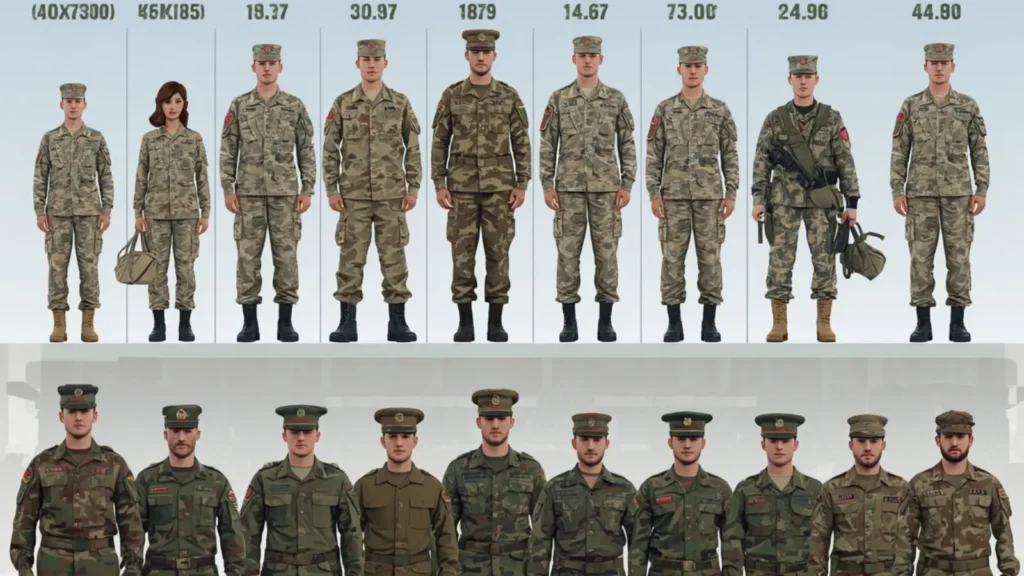
Height limits exist primarily for accession and equipment compatibility.
- Men (enlisted): Generally 60–80 inches (5’0″ to 6’8″).
- Women (enlisted): Generally 58–80 inches (4’10” to 6’8″).
Slight variations or waivers may apply for officers or specific situations. Heights outside this range can limit certain Military Occupational Specialties (MOS) involving vehicles, aircraft, or specialized gear. Once serving, ongoing minimum-height enforcement is minimal; the focus shifts to the WHtR.
Measurements at MEPS are taken barefoot (or in stocking feet) on a flat surface, chin parallel to the floor, body straight but not rigid, rounded to the nearest inch.
Enlistment Height and Weight Charts (Still Used at MEPS)
Accession standards at Military Entrance Processing Stations continue to use height-and-weight screening tables derived from the former AR 600-9 framework. Exceeding maximum weight typically requires further body-composition evaluation or may lead to the Future Soldier Preparatory Course fitness track.
Men – Sample Screening Weights (lbs)
| Height (in) | Min | Max 17–20 | Max 21–27 | Max 28–39 | Max 40+ |
| 60 | 97 | 132 | 136 | 139 | 141 |
| 65 | 114 | 155 | 159 | 163 | 165 |
| 70 | 132 | 180 | 185 | 189 | 192 |
| 75 | 152 | 206 | 212 | 217 | 220 |
| 80 | 173 | 234 | 240 | 247 | 250 |
Women – Sample Screening Weights (lbs)
| Height (in) | Min | Max 17–20 | Max 21–27 | Max 28–39 | Max 40+ |
| 58 | 91 | 119 | 121 | 122 | 124 |
| 60 | 97 | 128 | 129 | 131 | 133 |
| 65 | 114 | 150 | 152 | 154 | 156 |
| 70 | 132 | 174 | 176 | 178 | 181 |
| 75 | 152 | 200 | 202 | 204 | 208 |
| 80 | 173 | 227 | 230 | 233 | 236 |
Full tables cover every inch from the minimum heights upward. Minimum weights prevent underweight conditions that could impair performance or health. These charts remain the practical reference for applicants even after the July 2026 change for serving Soldiers.
How Tall Is the Average Soldier vs. the Average American?
Average adult male height in the United States is roughly 5’9″ (69–70 inches); female average is about 5’4″ (64 inches). Army height ranges comfortably encompass the vast majority of the population while excluding extremes that complicate uniform, body armor, vehicle, and aircraft accommodation.
The new WHtR standard aligns more closely with modern medical research on visceral fat and metabolic health than pure scale weight. A muscular 6’0″ Soldier at 220 lbs may have previously failed a weight chart but can easily pass a 39.5-inch or smaller waist. Conversely, a slender person with high central fat may now face closer scrutiny.
Height Comparisons with Other Celebrities and Athletes
While not military-specific, comparing Army height ranges to well-known figures helps visualize the standards:
- Tom Cruise (~5’7″) falls well inside both male and female ranges.
- Taylor Swift (~5’10″–5’11”) sits comfortably in the middle-upper range for women.
- Lionel Messi (~5’7″) and Cristiano Ronaldo (~6’1″) both fit easily within male limits.
- Barron Trump (reported around 6’7″–6’9″ in recent years) approaches or exceeds the practical upper end of 6’8″, which can create equipment challenges.
These comparisons illustrate that the Army accommodates a wide spectrum of adult body sizes while prioritizing functional fit and health.
Factors That Influence Height and Body Composition
Genetics set the primary ceiling for adult height (determined largely by parental height and growth-plate genetics). Nutrition during childhood and adolescence especially adequate protein, calcium, vitamin D, and overall calories supports reaching genetic potential. Sleep, physical activity, and absence of chronic illness or severe stress also matter.
Once growth plates close (typically late teens to early 20s), height stabilizes. Body composition, however, remains highly modifiable through:
- Strength training and progressive resistance work
- Balanced nutrition emphasizing protein and controlled energy balance
- Consistent sleep and stress management
- Avoiding extreme crash diets or dehydration tactics that temporarily shrink waist measurements but harm performance and health
The shift to WHtR rewards sustainable habits that reduce abdominal fat more than pure scale weight.
Timeline of Army Height and Weight Policy Changes
- Pre-2020s: Multi-site tape tests and age/gender-specific body-fat percentages after height/weight screening.
- Mid-2020s: Gradual simplification toward one-site tape and performance-based exemptions (e.g., high AFT scores).
- Late 2025–early 2026: Department of Defense direction toward waist-to-height ratio across services.
- July 7, 2026: Army Directive 2026-13 fully rescinds height/weight tables, tape tests, and supplemental methods (DXA, etc.) for the ABCP, establishing WHtR < 0.55 as the sole standard for serving Soldiers.
Accession standards at MEPS have lagged the change, retaining the familiar charts for initial screening.
Interesting and Surprising Facts About Army Height and Weight
- The 0.55 WHtR cutoff is stricter than some civilian health guidelines that use 0.5 as a healthy threshold, reflecting military performance demands.
- A 72-inch (6’0″) Soldier passes with a waist under 39.6 inches roughly a 39.5-inch reading is the practical limit.
- There is no longer an age or gender adjustment; the same ratio applies to an 18-year-old private and a 45-year-old sergeant major.
- Extremely tall or short applicants may receive MOS restrictions even if they meet overall height windows.
- The Future Soldier Preparatory Course offers a structured path for applicants who miss weight or body-composition targets at MEPS.
Army Height and Weight vs. Average Person and Other Services
Compared with civilian BMI categories, the old Army tables allowed somewhat higher weights for taller or older individuals, acknowledging muscular development. The new WHtR is more health-oriented and uniform. Other services have also moved toward or adopted similar ratio-based approaches, creating greater joint-force consistency.
Frequently Asked Questions
How tall do you have to be to join the Army?
Men generally need to be between 5’0″ and 6’8″; women between 4’10” and 6’8″. Exact measurements occur at MEPS.
What is the current Army height and weight standard in 2026?
For serving Soldiers it is a waist-to-height ratio under 0.55. For enlistment, traditional height-and-weight charts still apply at MEPS.
What is Army height in feet and centimeters?
Minimum male ~5’0″ (152 cm), maximum ~6’8″ (203 cm). Female minimum ~4’10” (147 cm). Always convert precisely using official measurements in inches.
Are Army Soldiers taller than the average person?
The allowable range covers most of the population. Average Soldier height tends to cluster near the U.S. adult averages because extremes are less common and can face practical limitations.
Has Army height and weight changed over time?
Yes. The biggest recent change occurred in July 2026 when height/weight tables and tape tests were replaced by WHtR for the Army Body Composition Program. Enlistment screening retained the older charts longer.
How does Army height and weight compare with other celebrities?
Most celebrities fall comfortably inside the Army ranges. Extremely tall or short public figures may sit near the edges of the allowable windows.
Conclusion
Army height and weight standards in 2026 center on a clear, modern metric for serving Soldiers the waist-to-height ratio below 0.55 while enlistment still references familiar height-and-weight charts.
These rules exist to support readiness, health, equipment compatibility, and long-term performance.
Understanding both the current WHtR requirement and the accession tables, along with the genetic, nutritional, and lifestyle factors that shape body size, helps applicants and Soldiers prepare effectively.
Whether you are considering joining or maintaining standards, accurate measurement, consistent training, and healthy habits remain the most reliable path to success.
Always verify the latest official guidance through Army channels or a recruiter, as policies can continue to evolve.

Expert in crafting motivational and inspirational caption content.